

Projects
Software tools and open-source resources developed by the Material Sensing & Simulation Lab for high-frequency material characterization and electromagnetic modeling.
Skin Sensing
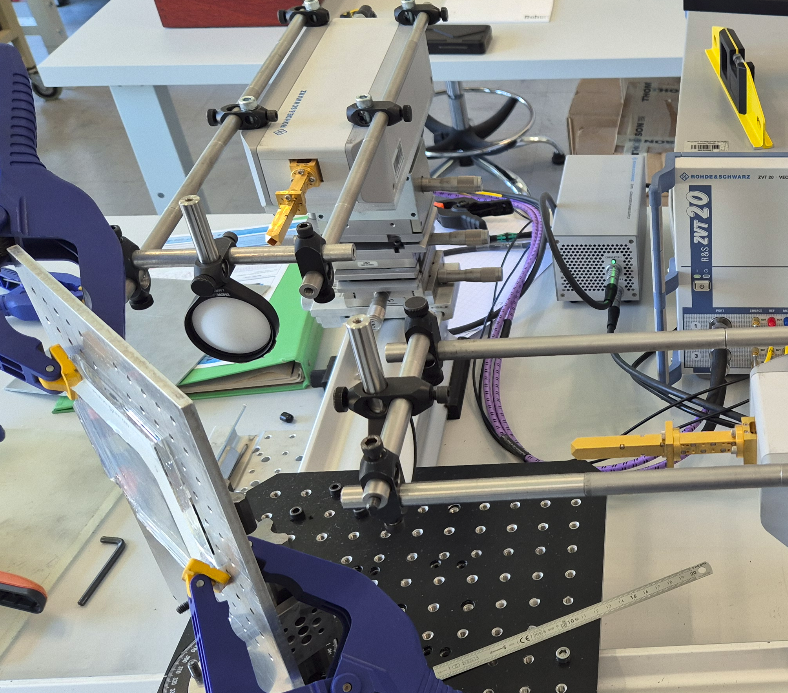
This project investigates the dielectric properties of human skin at millimeter-wave and THz frequencies, with the goal of enabling non-invasive sensing and monitoring applications. Using a free-space quasi-optical measurement bench, we extract the complex permittivity of skin and skin-mimicking phantoms from GHz to THz regimes. The approach combines accurate electromagnetic modeling with experimental measurements, leveraging the QOSM simulation framework and pycarmat characterization toolkit developed in the lab. Applications include biomedical sensing, hydration monitoring, and non-destructive evaluation.
Material Characterization
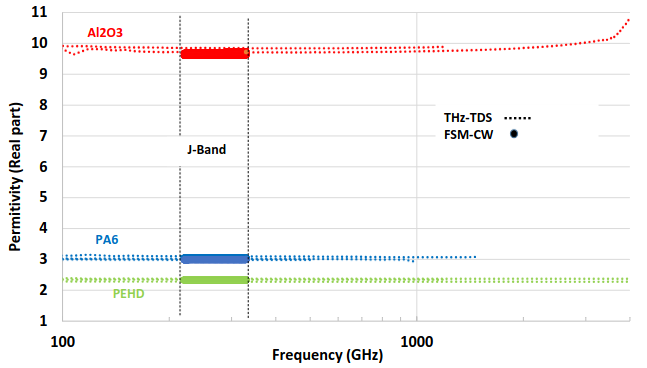
This project conducts an interlaboratory comparison of dielectric material characterization using two complementary measurement approaches: continuous-wave (CW) free-space systems operating in the millimeter-wave range and time-domain spectroscopy (TDS) systems covering the THz band. By comparing permittivity extraction results obtained with both techniques on common reference samples, this work assesses the consistency, accuracy, and complementarity of the two methods across overlapping frequency ranges. The study involves collaboration between IMT Atlantique (Lab-STICC) and external partners, and contributes to the establishment of reliable measurement protocols for broadband dielectric characterization of materials.
Antenna Characterization with Robotic Arm
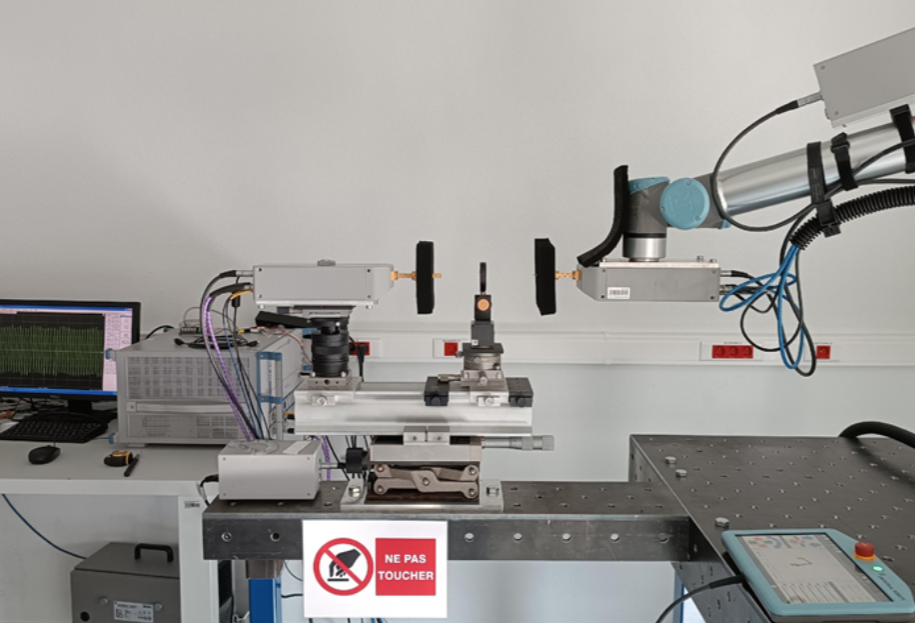
This project uses a six-degree-of-freedom UR10e collaborative robotic arm (Universal Robots) for millimeter-wave field measurements and material characterization. The experimental setup consists of a static emission/reception head connected to a diagonal horn and a PTFE lens, while the robotic arm — controlled via its digital twin in RobotDK and a Python script — positions a second emission/reception head for field scanning. A vector network analyzer (VNA) measures the transmission parameters of the full system. The robot performs planar scans of the field distribution, with results showing good agreement between measurements and simulation in terms of beam intensity and collimation. Phase ripples observed in measurements were found to depend on the robot scan axis order, highlighting the importance of motion sequencing for accurate field characterization.
Software

pycarmat is an open-source Python package developed at IMT Atlantique for dielectric material characterization from free-space S-parameter measurements, with a focus on millimeter-wave and THz frequency bands. It provides a full pipeline from raw VNA measurements to extracted permittivity, supporting single-layer and multilayer samples. The toolkit includes a GUI application, a quasi-optical bench simulation module (QOSM), and command-line interfaces for measurement acquisition, permittivity extraction, and multilayer optimization. Install via pip install pycarmat or from the GitLab repository.
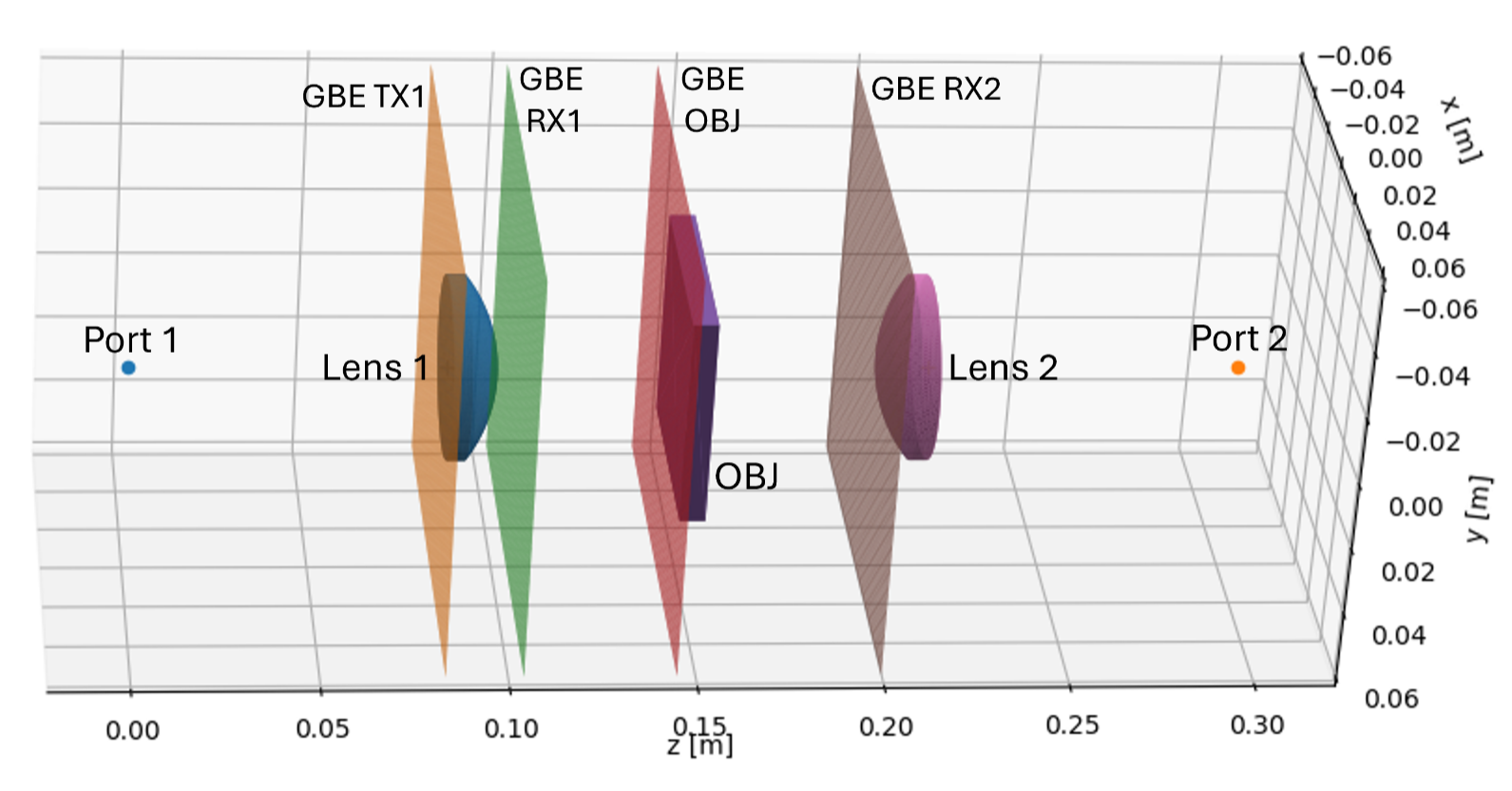
QOSM (Quasi Optical System Modelling) is an open-source simulation module developed at IMT Atlantique (Microwave Department, Lab-STICC) for modelling quasi-optical systems used in millimeter-wave and sub-millimeter-wave material characterization. It combines Gaussian beam expansion and tracking with modal analysis, and provides S-parameter analysis for comparing simulated versus measured data, as well as TRL calibration for de-embedding dielectric properties from free-space measurements. Install via pip install qosm or from the GitLab repository.